I am a historian of ideas, knowledge, and narratives. My work has mostly been about how people responded to the world around them: to political and economic conditions, and to each other’s words about those conditions. I’ve studied how social realities shaped people’s ideas, and how those ideas, in turn, shaped reality, often through the impact of the written word.
Now, in just a few short years, we’ve entered an era where all of this began to function differently. A long-imagined dream (or nightmare) has become everyday reality: thinking with machines. Social media is full of ironic clips about ‘writing’ essays with a few clicks. Professors sigh and wonder if there’s any point left in assigning essays at all.
But there are also more ‘serious’ developments: A young novelist in Japan recently won a major literary prize for a book written with ChatGPT.
Terrible? Exciting? Both?
Either way, something fundamental is shifting in how we think, write, and produce knowledge, or at least it seems to be. Part of my curiosity is to ask whether this really marks a radical break, or if we are simply seeing new forms of older patterns. As someone who studies how people have learned, argued, and created knowledge in the past, I want to trace these continuities and ruptures, and to think about what they might mean for the future of humanity.
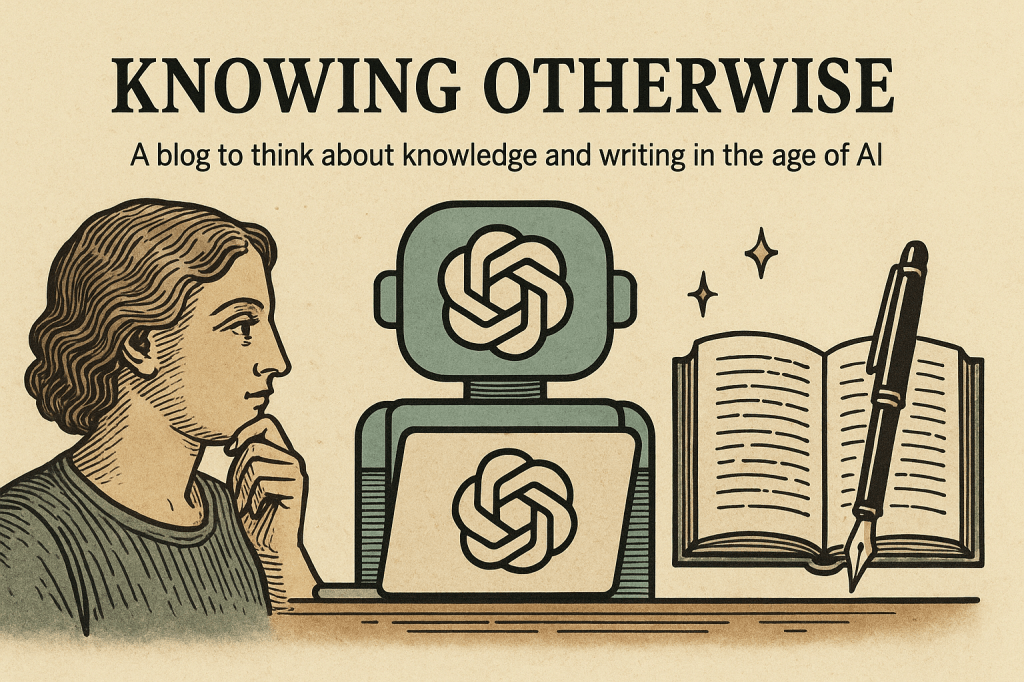
And since this blog is about knowledge and writing in the age of AI, I’ll practice what I preach. Every post here will be written with the help of AI tools — but not by them. I’ll use them to spark ideas, test outlines, and polish drafts, while keeping the thinking and voice my own. I’ll also add AI-generated visuals to each post, as part of the same experiment.
This blog is where I’ll think out loud about these questions through informal notes, reflections, and experiments. Nothing too polished, but hopefully curious enough to spark thought.
Let’s begin.
 The National Mind
Leave a comment